


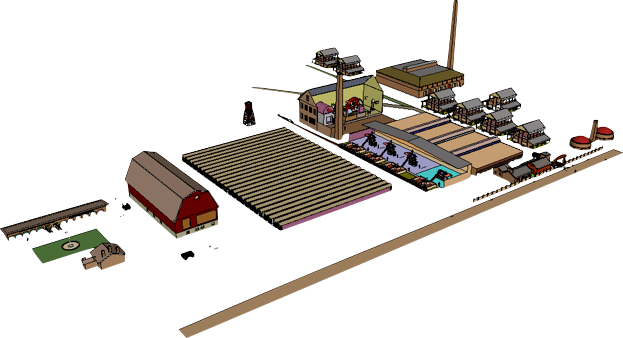
Brick-Yard Layout


The above illustration was produced using the computer program titled “Sketch-Up”. Armed with the 1900 3-page text description and the six 1900 pictures of the Yard produced by the editors of the Bulletin for the New York State Museum then researching the large collection of digitized articles, newspapers and books on-line allowed the detail dimensions to be accessed for rendering of the Brick-Yard illustration.

Oh!..yes the “Otis Papers”, a collection of the Otis family papers accessible at the Strong Museum Library also provided Yard details.  William Otis  (1804-1879) was the founder of the RB&TCo. and his son Ira Late Otis (1834-1898) succeeded him as firm President. Notes within this collection give details to equipment and daily operation procedures.


3-D Brick-Yard Illustration / Sketch-Up


Sketch-Up

SketchUp debuted in August 2000 as a general purpose 3D content creation tool, with the tagline

"3D for Everyone"

Key to its early success was a shorter learning period than other 3D tools.

Google acquired @Last Software on March 14, 2006,

Support Systems

Brick Drying Pallets

Clay Transport

Power Center

Brick & Tile Mfg. Building

Kilns

Tile Drying Sheds

Note: This Brickyard was organized for efficiency.

Notice the grouping of kiln locations which require many, many men to set up brick and maintain the burning process. Then the brick and tile machines, which are dependent on the steam engine power, are placed in line to gain access from a single belted power line. The drying sheds, for both brick and tile, are placed next to the presses to minimize traffic and maintain high production.The rail system delivering the clay has a direct access to the clay mixing pits in front of the machines.

A 1900 YARD... arranged for efficient use of man power.

Office, Store & Scales